


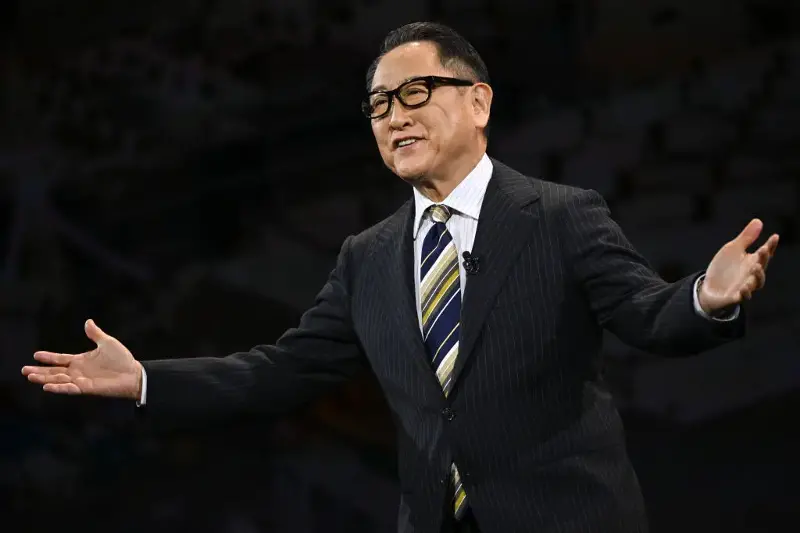
From his early childhood, Akio Toyoda “nurtured a fascination” for his grandfather, Kiichiro – the Japanese industrial visionary who turned the family loom-making business into a fully fledged carmaker and died aged 57 in 1952, a few years before Akio was born, says the Financial Times. When Toyoda himself turned 57, “he made a pilgrimage to his grandfather’s tomb”, promising to fulfil his dreams for the family group.
Of late, that vow has taken a controversial turn. In a move seen by some as a “power play”, Toyoda – who ran Toyota Motor for 14 years before being kicked upstairs to become chairman in 2023 – has orchestrated the $33 billion buyout of the original parent company, Toyota Industries. Opinion is divided on whether the “take-private” deal is “a step forward or back for corporate governance in Japan”, says Bloomberg. On the one hand, investors and officials have long sought the dissolution of “parent-child listings”, such as Toyota Industries, due to their lack of independent oversight. On the other, the deal might be seen as a reassertion of control by the Toyoda family, which technically owns a combined stake of less than 2% in the carmaking company. Toyota Industries, while smaller, still packs a punch: it is the world’s largest manufacturer of forklift trucks.
The deal certainly carries “deep symbolic weight”, says New York’s Observer. It’s also complex. Control of Toyota Industries now shifts to Toyota Fudosan – “an unlisted real-estate firm that serves as the Toyoda family’s private investment vehicle”. Some shareholders allege wheeler-dealing. Not only has Toyoda grabbed the company for less than the $42 billion expected, but he’s contributing just $7 million of his personal wealth to the deal, with the rest funded by Toyota companies and bank loans. Whichever way you dress it up, this is a move “to consolidate” family power across the empire. The move is perhaps all the more surprising because Toyoda’s interest in the business appeared to have taken a backseat to his passion for motor-racing in recent years.
“A certain solitude” has always defined Akio Toyoda’s life, says the FT. Born in Nagoya, Japan, in 1956 – a year after Toyota launched Japan’s first domestically produced passenger car – he grew up privileged but also “isolated”. His first taste of life as “a normal person” came when he attended Babson College in Massachusetts for his MBA, because in the US, no one recognised his name.
After a few years working for investment bank AG Becker and consulting firm Booz Allen Hamilton, he joined Toyota in 1984 when his father, Shoichiro, was still president. He took on the role himself in 2009 just as the global crisis dragged Toyota into a $4.4 billion loss, its first since 1950. A safety recall compounded the sense of crisis. But he pulled through and succeeded in “firmly cementing Toyota’s place as the world’s largest carmaker by volume”, partly because of his scepticism about the pace of transition to electric cars. Toyota’s annual revenues now account for roughly 8% of Japan’s nominal GDP.
Investors should hand Akio Toyoda the keys
“My life has always been about wrestling with the question of whether I am a person needed by Toyota or not,” Toyoda once observed. The odd thing, says Bloomberg, is that he doesn’t get much credit either for this self-awareness or for the resilience of the company on his watch. At last year’s AGM, “fully two-thirds of foreign institutional investors opposed his re-election as a director”, and his overall support rate among shareholders, at 72%, “was the lowest of any director in Toyota’s history”. Given his record of delivering shareholder returns that dwarf those of peers, this is “nonsensical”. Rather than griping about Toyoda’s role as a backseat driver, “investors should be handing him the keys”.